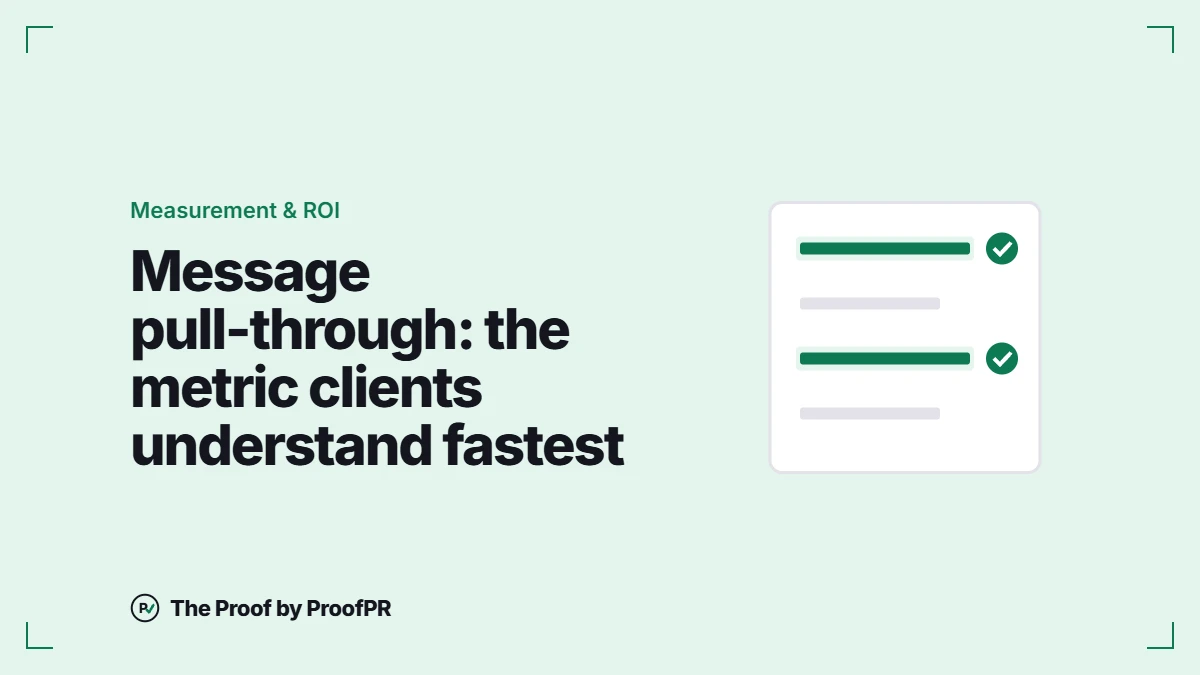
Coverage counts tell a client how much was written. Message pull-through tells them whether it said the right things. In our experience it is the metric clients grasp fastest, because it maps directly onto the brief they gave you.
What message pull-through means
At the start of a campaign or retainer, you agree two to four key messages with the client. For a payroll startup, these might be: “built for Indian compliance”, “set up in a day” and “trusted by 5,000 businesses”.
Message pull-through is the share of stories that carried each message. If 20 stories ran and 12 mentioned Indian compliance, pull-through for that message is 60%.
Fewer messages, scored honestly, beat a long list nobody can remember.
How to score each story
Read each story and mark every key message with one of three scores:
- Full: the message appears clearly, in the journalist’s words or a quote.
- Partial: the idea is there but weakened, buried or unattributed.
- None: the message doesn’t appear.
Count full as 1 and partial as 0.5. Keep a short note when you score partial, so a colleague would reach the same score.
Key takeaway
Write the scoring rule down once, and have a second person check a few stories each month.
Add a negative check
Also note any message you did not want: an outdated fact, a competitor’s claim, a criticism repeated from an old story. One line in the report (“2 stories repeated the 2023 pricing complaint”) is often more useful to the client than another positive number.
How to report it
Show a simple table: each key message, the number of stories carrying it, and the percentage, with last month’s figure beside it. Then add one line on why it moved: “Compliance message rose after the GST webinar coverage.”
Put the headline figure on the summary page of your monthly PR report, and the per-story scores on each clip page.
Why it matters more now
AI assistants such as ChatGPT and Perplexity summarise what has been published about a brand. If your key messages rarely appear in coverage, they rarely appear in AI answers either. In a real snapshot we ran of the food brand The Whole Truth, the assistant described its positioning accurately but missed its newest product line and recent growth, because those messages are less established in what it learned from.
You can see that example in our sample AI snapshot, and read more in what AI visibility is. Strong message pull-through in coverage is the most reliable way to change what AI says.