Share of voice is one of the few PR metrics that both marketers and CEOs understand without explanation. It answers a simple question: of all the coverage about our category this month, how much was about us?
It is also easy to calculate badly. Here is how to do it properly.
The basic formula
Share of voice = your brand’s mentions ÷ total mentions of your brand and the named competitors × 100.
If your client was mentioned in 18 stories and three competitors were mentioned in 12, 10 and 20 stories, the client’s share of voice is 18 ÷ 60 = 30%.
Name the competitors with the client before you start, and keep the list fixed for the year.
Decide what counts as the conversation
The number only means something if the boundaries are clear. Agree three things with the client:
- Competitors: two to four named companies the client genuinely competes with for customers or talent.
- Publications: the titles that matter to the audience, not every site that mentions a brand name.
- Topics: the category conversation, for example “payroll software” or “protein snacks”, not every story where a company appears.
Without these, share of voice rises and falls for reasons nobody can explain.
Weight it, carefully
A passing mention in a list is not the same as a feature. Many teams weight mentions simply:
- Headline or main subject: 3
- Substantial mention or quote: 2
- Passing mention: 1
Keep the weighting simple and written down. If you change it, restate earlier months so the trend stays honest.
Key takeaway
A consistent, simple method beats a clever one that changes every quarter.
Common mistakes
- Counting syndicated copies of one wire story as separate mentions
- Including competitors’ paid or sponsored content in their total
- Comparing a month with a big announcement against a quiet month without saying so
- Reporting share of voice without saying which competitors were included
How to show it in a report
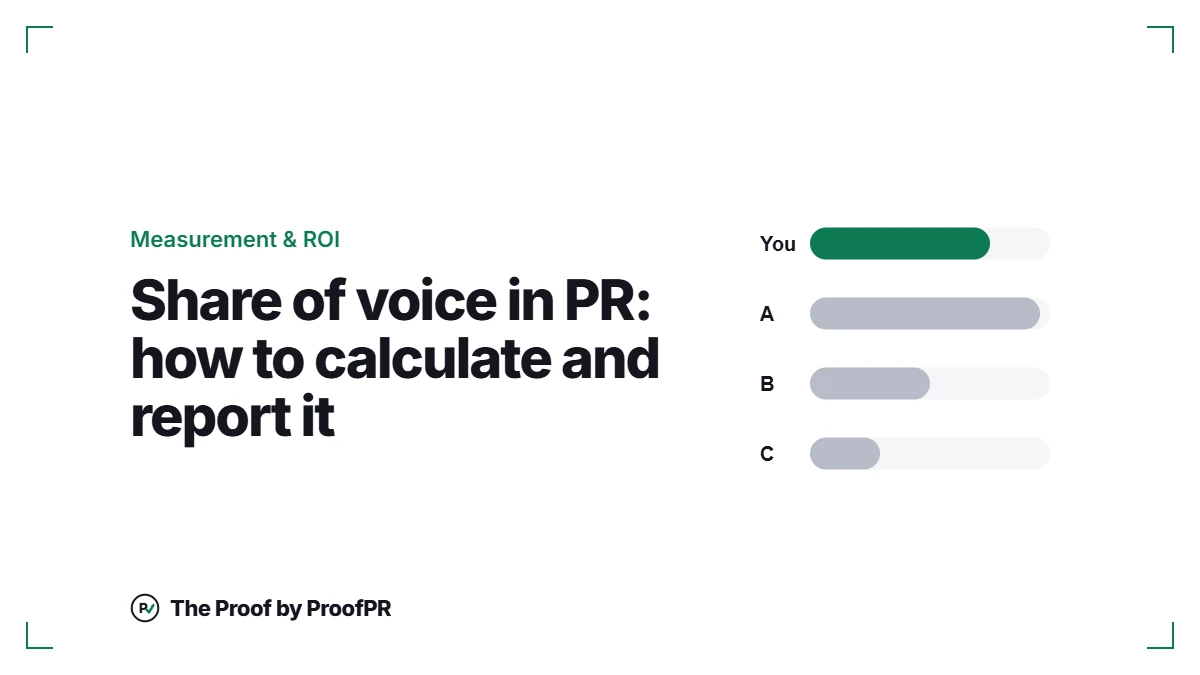
A horizontal bar for each company, sorted by share, with your client highlighted, works better than a pie chart. Show the last three or six months as a small trend line underneath. Add one sentence explaining any big movement: “Competitor B’s spike came from its IPO filing.”
Share of voice sits alongside message pull-through: one tells you how much of the conversation you own, the other whether it says what you want. Together they make a strong core for a monthly PR report.
Share of voice in AI answers
The same idea now applies to AI assistants. Ask ChatGPT, Gemini, Claude and Perplexity the questions your client’s buyers ask, such as “best payroll software for small businesses in India”, and count how often each brand is named. That is AI share of voice, and it can look very different from media share of voice.
ProofPR’s AI Visibility Audit measures exactly this across four assistants, with the competitors you name.